
Naturally Curious Book Club
Have you been looking for a nature-centric book club to join? The Nature Institute invites all who are interested to read along with us this winter. We will meet in person once a month to discuss the book, and there will be an online discussion available to anyone interested, but unable to join in person.

The Comfort of Crows by Margaret Renkl
In Person: Wednesday, December 3, starting at 10 am
In The Comfort of Crows, Margaret Renkl presents a literary devotional: fifty-two chapters that follow the creatures and plants in her backyard over the course of a year. As we move through the seasons—from a crow spied on New Year’s Day, its resourcefulness and sense of community setting a theme for the year, to the lingering bluebirds of December, revisiting the nest box they used in spring—what develops is a portrait of joy and grief: joy in the ongoing pleasures of the natural world, and grief over winters that end too soon and songbirds that grow fewer and fewer.
Along the way, we also glimpse the changing rhythms of a human life. Grown children, unexpectedly home during the pandemic, prepare to depart once more. Birdsong and night-blooming flowers evoke generations past. The city and the country where Renkl raised her family transform a little more with each passing day. And the natural world, now in visible flux, requires every ounce of hope and commitment from the author—and from us. For, as Renkl writes, “radiant things are bursting forth in the darkest places, in the smallest nooks and deepest cracks of the hidden world.”
With fifty-two original color artworks by the author’s brother, Billy Renkl, The Comfort of Crows is a lovely and deeply moving book from a cherished observer of the natural world.
Where the Deer and Antelope Play by Nick Offerman
In Person: Thursday, January 8, starting at 10 am
Nick Offerman has always felt a particular affection for the Land of the Free—not just for the people and their purported ideals but to the actual land itself: the bedrock, the topsoil, and everything in between that generates the health of your local watershed. In his new book, Nick takes a humorous, inspiring, and elucidating trip to America’s trails, farms, and frontier to examine the people who inhabit the land, what that has meant to them and us, and to the land itself, both historically and currently.
In 2018, Wendell Berry posed a question to Nick, a query that planted the seed of this book, sending Nick on two memorable journeys with pals—a hiking trip to Glacier National Park with his friends Jeff Tweedy and George Saunders, as well as an extended visit to his friend James Rebanks, the author of The Shepherd’s Life and English Pastoral. He followed that up with an excursion that could only have come about in 2020—Nick and his wife, Megan Mullally, bought an Airstream trailer to drive across (several of) the United States. These three quests inspired some “deep-ish” thinking from Nick, about the history and philosophy of our relationship with nature in our national parks, in our farming, and in our backyards; what we mean when we talk about conservation; and the importance of outdoor recreation, all subjects very close to Nick’s heart.
With witty, heartwarming stories and a keen insight into the human problems we all confront, this is both a ramble through and celebration of the land we all love.

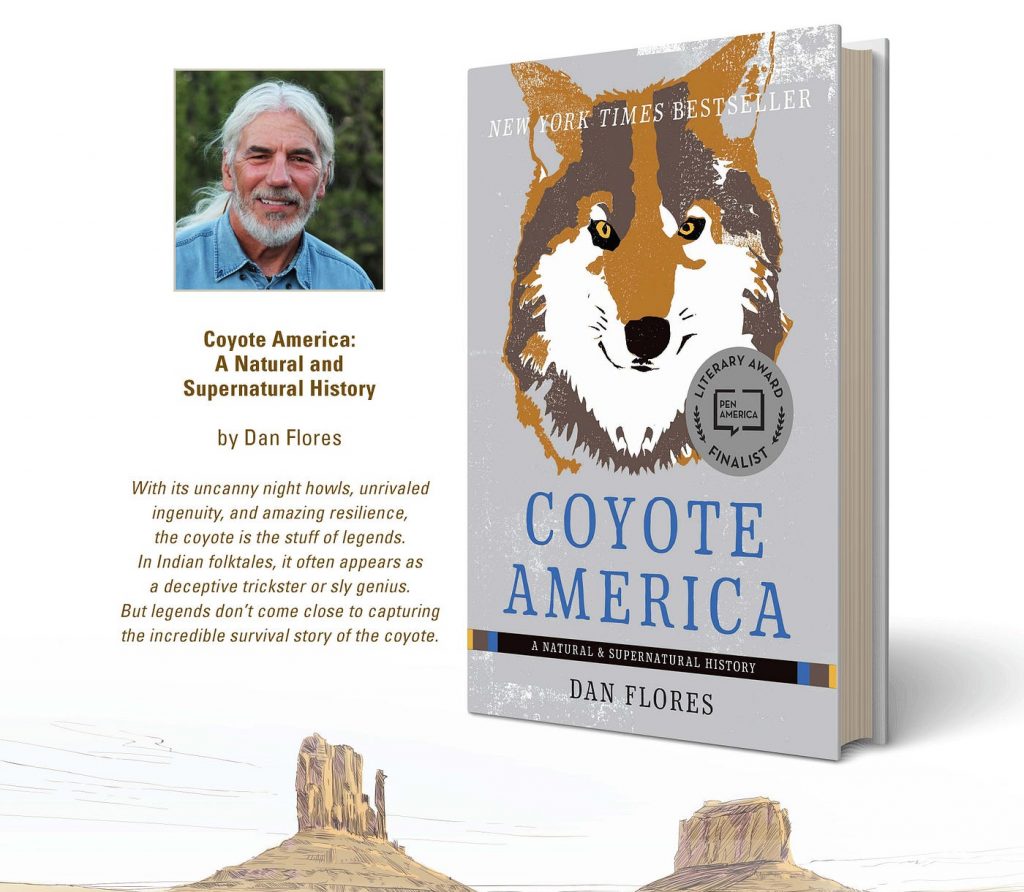
Coyote America by Dan Flores
In Person: Thursday, February 5, starting at 10 am
Legends don’t come close to capturing the incredible survival story of the coyote. In the face of centuries of annihilation campaigns employing poisons, gases, helicopters, and bioweapons, coyotes didn’t just survive, they thrived, expanding across North America from Alaska to Florida and New York, and now, as this new edition explores, to South America as well. In the war between humans and coyotes, coyotes have won hands-down.
Coyote America traces both the five-million-year-long biological story of coyotes, as well as their cultural evolution from preeminence in Native American religions to haplessness before the Road Runner. A deeply American tale, the story of the coyote in the American West and then across the entire country is a sort of Manifest Destiny in reverse, with a pioneering hero whose career holds up an uncanny mirror to the successes and failures of American expansionism.
An illuminating biography of an extraordinary animal, Coyote America is one of the great epics of our time.
Bite by Bill Schutt
In Person: Thursday, March 5, starting at 10 am
In Bite, zoologist Bill Schutt makes a surprising case: it is teeth that are responsible for the long-term success of vertebrates. The appearance of teeth, roughly half a billion years ago, was an adaptation that allowed animals with backbones, such as fish, amphibians, reptiles, birds, dinosaurs and mammals—including us—to chow down in pretty much every conceivable environment.
And it’s not just food. Tusks and fangs have played crucial roles as defensive weapons—glimpsing the upper canines of snarling dogs is all it takes to know that teeth are an efficient means of aggression. Vampire bats use their razor-sharp teeth to obtain a widespread but generally untappable resource: blood. Early humans employed their teeth as tools to soften tough fibers and animal hides. Our teeth project information and social status—the ancient Etruscans were the first to wear tooth bling, and it’s doubtful that George Washington would have been elected president without the false teeth he wore.
So much of what we know about life on this planet has come from the study of fossilized teeth, which have provided information not only about evolution but also about famine, war, and disease. In his signature witty style, the author of Pump and Cannibalism shows us how our continued understanding of teeth may help us humans through current and future crises, from Alzheimer’s disease to mental health issues.
